
Herbert Alexander Simon

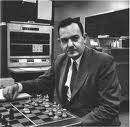
- (b.) 1916 June 15 - (d.) 2001 February 09
Bio/Description
One of the most influential social scientists of the twentieth century, Simon was an American political scientist, economist, and psychologist whose research ranged across the fields of cognitive psychology, computer science, public administration, economics, management, philosophy of science, sociology, and political science. He had almost a thousand very highly cited publications.
Simon was awarded the Nobel Memorial Prize in Economic Sciences in 1978 for his pioneering research into the decision-making process within economic organizations. He also received the Turing Award in 1975, along with Allen Newell, for contributions to artificial intelligence, the psychology of human cognition, and list processing. His work on decision-making led him to develop the concept of bounded rationality, which described how individuals made decisions within the limits of the information available to them, rather than with perfect knowledge.
Simon's interdisciplinary approach made him one of the most influential social scientists of the twentieth century. He was a professor at Carnegie Mellon University for most of his career, contributing to the university's reputation in computer science and cognitive science. His book Administrative Behavior, first published in 1947, describes how organizations make decisions and remains a foundational text in management and organizational theory.
Simon also played a central role in the development of artificial intelligence as a field of study. Together with Allen Newell and J. C. Shaw, he developed the Logic Theorist and the General Problem Solver, two of the earliest artificial intelligence programs. These contributions helped establish AI as a legitimate area of academic research.
Citations:
-
Date of Birth:
1916 June 15 -
Date of Death:
2001 February 09 -
Gender:
Male -
Noted For:
One of the most influential social scientists of the 20th century -
Category of Achievement: