
Allan Marquand

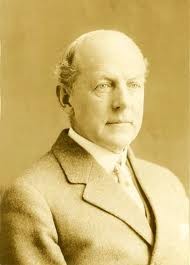
- (b.) 1853 December 10 - (d.) 1924 September 24
Bio/Description
Builder of a mechanical logical machine that is still extant, Marquand is described as having created "…mills into which the premises are fed and which turn out the conclusions by the revolution of a crank."
An art historian at Princeton University and a curator of the Princeton University Art Museum, Marquand graduated from Princeton in 1874 and obtained his Ph.D. in Philosophy in 1880 at the Johns Hopkins University. His thesis, supervised by Charles Sanders Peirce, was on the logic of Philodemus. He returned to Princeton in 1881 to teach Latin and logic.
During the 1881–82 academic year, he built a mechanical logical machine that is still extant; Marquand was inspired by related efforts of William S. Jevons in the UK. In 1887, following a suggestion of Peirce's, he outlined a machine to do logic using electric circuits. This necessitated his development of Marquand diagrams.
According to Lavin (1983: 8), the President of Princeton, McCosh, deemed "unorthodox and unCalvinistic" his relatively mathematical approach to the teaching of logic, an approach he had learned at Peirce's feet. Hence in 1883, Marquand was offered a position teaching art history, a position at which he excelled and which he held until his death. He was elected chairman of the Department of Art and Archaeology in 1905. He also served as the first director of the Princeton University Art Museum, a position Marquand held until his 1922 retirement.
Citations:
-
Date of Birth:
1853 December 10 -
Date of Death:
1924 September 24 -
Gender:
Male -
Noted For:
Builder of a mechanical logical machine which is still in existence, described as, “…mills into which the premises are fed and which turn out the conclusions by the revolution of a crank” -
Category of Achievement: