
Arlene Joy Harris

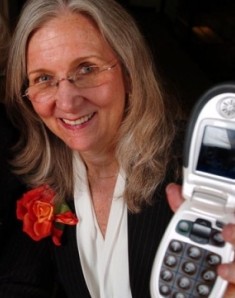
- (b.) 1948 June 06
Bio/Description
Pioneer of the first automated cellular service activation systems now used globally in retail locations to remotely and instantly activate cellular phones, Harris is also known as the "First Lady of Wireless" — a serial entrepreneur, inventor, investor, and policy advocate. Her career has spanned a lifetime of innovation in mobile services and systems technology and, later, wireless consumer products and services. She started and built several successful companies, pioneered many of the early cellular industry standards, and holds numerous issued wireless communications patents. In May 2007, she won industry-wide acclaim as the first woman inducted into the Wireless Hall of Fame.
Harris has served as co-founder and CEO of Dyna LLC, in Del Mar, California, where she incubated new ideas and businesses with husband and business partner Martin Cooper, a former Motorola Vice-President and Division Manager who developed and introduced the first handheld cellular mobile phone in 1973. She was born in Los Angeles, California, and began her career at the age of 12 as a mobile telephone switchboard operator for her family's business, Industrial Communications Systems Inc. (ICS) (sold to Metromedia in 1983, now USA Mobile) in Los Angeles, California. In 1969, she left ICS for a formative stint with Air Canada and Continental Airlines, helping to scale their business operations in preparation for the new wide-bodied airplanes. She returned to ICS three years later.
In 1981, under her guidance, ICS developed the first wireless consumer healthcare application, called "Life Page," a program that provided pagers to organ transplant recipients. Harris later promoted and expanded the program to the National Trade Association for independent wireless operators Telocator, which later became the Personal Communications Industry Association. ICS created state-of-the-art communication and, under her direction, became the largest single-city paging system in the world. Most notably, ICS was among the first of any category of business to create online computer systems to manage the company's business subscriber offering.
While selling directly to businesses, ICS also supported the first wholesale wireless service in history, starting in 1972. The wholesale model promoted substantial growth and shareholder value for ICS, its suppliers, and its partners. Because of the success of ICS's wholesale strategy in bolstering the opportunities for partners and service adoption by new users, the resale concept was mandated by the U.S. Federal Communications Commission (FCC) in the original cellular spectrum allocations in 1982.
In 1983, she co-founded Cellular Business Systems Inc. (CBSI) (sold to Cincinnati Bell, now Convergys), where Harris guided the development of the leading billing/CRM service bureau in the early cellular industry. She personally specified and directed the development of the first automated cellular service activation systems now used globally in retail locations to remotely and instantly activate cellular phones. While at CBSI, she served as one of three FCC committee members challenged to develop intersystem roaming protocols. The committee was established to create the methods by which cellular companies enable and bill customers who visited their networks, and its work resulted in the Cellular Inter-carrier Billing Exchange Record (CIBER), used throughout the cellular industry.
In 1986, she launched Dyna LLC in Chicago, Illinois, and later relocated to Del Mar, California, as a home base to incubate and spin out new ideas and help young companies. Also in 1986, Harris founded Cellular Pay Phone, Inc. (CPPI), where she developed her first patented invention—the first program-controlled end-to-end management system (created with OKI Electronics and Motorola). This offering made CPPI the first niche cellular reseller in history to create a special cellular phone and a tightly integrated system to support cellular with automated payments by credit card. These phones were ultimately deployed in taxis, limousines, rental cars, on oil platforms, and on public transportation such as trains and ferries (licensed to GTE, now Verizon). This payphone program innovated many of the techniques commonly used today by companies like Apple and RIM.
As founder of software company Subscriber Computing, Inc. in 1986, her team built and delivered systems to the largest paging companies in the world and provided the first converged billing systems for cellular and the Internet to global leaders, including British Telecom and Hutchinson. In 1988, Harris innovated and led the company's implementation of the first communications methods used to support access to cellular services by low- and no-credit consumers. The concept became known as "prepaid" cellular service and grew to become one of the primary forms of subscriber relationship and payments in the cellular industry. She used some of the same techniques to innovate systems used to prevent the fraudulent use of cellular phones.
Under her guidance, SOS Wireless Communications (which she founded in 1994) developed the first consumer-oriented reseller of cellular service designed especially for safety. Like the payphone business, SOS developed a custom phone and service for making outgoing calls for urgent communications. SOS customers were primarily older Americans who adopted cellular service to keep them safe while on the road. Harris acquired cellular carrier Accessible Wireless in 2001 to provide a home carrier service for offerings targeting typically low-usage applications. Accessible and SOS both supported the founding of her next company, GreatCall, in 2004—the first complete end-to-end value-added service provider in the cellular industry to focus on simplicity, with primary emphasis on baby boomers and senior citizens.
It was at GreatCall that she innovated and led the development of the Jitterbug phone, in partnership with Samsung, to create a simple and personalized cell phone experience that anyone, regardless of technological "know-how," could use and enjoy. The Jitterbug and its service earned top honors as one of the New York Times's top 10 greatest technology ideas of 2006 (as judged by David Pogue), as a finalist in Yahoo's "Last Gadget Standing" competition at the Consumer Electronics Show in 2007, and as a Reader's Digest "Top 100 Products" selection. Additionally, GreatCall won the wireless industry's coveted Andrew Seybold Choice Award for "Best New Company" at CTIA in 2007 and the American Society on Aging's Award for "Best Small Business" in 2008.
Harris received numerous individual honors during this period as well. In October 2008, she was named a Fierce Wireless "Top U.S. Wireless Innovator of All Time." In May 2008, she was awarded the ATHENA Pinnacle Award, recognizing prominent executives and companies in San Diego that support, encourage, and advance high-level opportunities for women. In October 2008, she and Jitterbug received the Stevie Award for "Best Overall Company of the Year—Service Business" and "Technology Innovator of the Year." The Stevie Awards for Women in Business honor women executives, entrepreneurs, and the companies they run, worldwide.
Among her other recognitions, Harris received the Personal Communications Industry Association (PCIA) Chairman's Award in 2000. She was a founding member of the FCC/TIA committee on cellular roaming (1985) and was named a Fellow of the Radio Club of America in 1987. From 2004 onward, she has served on the Illinois Institute of Technology Board of Trustee Committees. In May 2007, she became the first female inductee into the Wireless Hall of Fame, a joint effort of RCR Wireless News and the Cellular Telecommunications and Internet Association (CTIA). In 2008, she founded the Wireless History Foundation, whose mission is to educate and enlighten about wireless's rich history by providing access to consumers, researchers, enterprise, and government entities.
Citations:
-
Date of Birth:
1948 June 06 -
Gender:
Female -
Noted For:
Directed the development of the first automated cellular service activation systems now used globally in retail locations to remotely and instantly activate cellular phones -
Category of Achievement: